


How Much Does Embroidery Digitizing Cost in 2026?

If you're planning to embroider your business logo on uniforms, create custom merchandise, or turn your artwork into a machine embroidery design, one of your first questions is probably: How much does embroidery digitizing cost?
In 2026, professional embroidery digitizing typically costs around $10–$25 for a small logo, while larger or more complex designs can cost $40–$80 or more. The final price depends on the size of your artwork, stitch count, design complexity, and the pricing structure of your digitizing provider.
At Apex Embroidery Designs, custom embroidery digitizing starts at just $18.99, with straightforward pricing based on design size.
But before choosing a service, it helps to understand what you're actually paying for, which factors influence the price, and how to avoid unnecessary expenses.
This guide breaks down embroidery digitizing costs in 2026 so you can make an informed decision.
How Much Does Embroidery Digitizing Cost in 2026?
Embroidery digitizing prices vary considerably between providers. Some charge a fixed fee per design, while others calculate prices based on stitch count or the complexity of the artwork.
Here are some general price ranges you may encounter when shopping for embroidery digitizing services:
| Design Type | Estimated Digitizing Cost |
|---|---|
| Simple text or monogram | $5–$15 |
| Small business logo | $10–$25 |
| Medium-sized detailed logo | $20–$45 |
| Large jacket-back design | $40–$80+ |
| Highly complex custom artwork | Custom quote |
These figures are indicative market ranges, not guaranteed quotes or industry-wide averages. Actual prices vary by provider, artwork, and project requirements.
For example, a small company logo with basic lettering may cost significantly less than a detailed illustration featuring gradients, fine outlines, and several overlapping elements.
However, a higher price doesn't automatically mean better quality. Likewise, the cheapest service isn't always the most economical choice.
The most important consideration is whether your digitized file will produce clean, consistent embroidery on your intended material.
Custom Embroidery Digitizing Prices at Apex
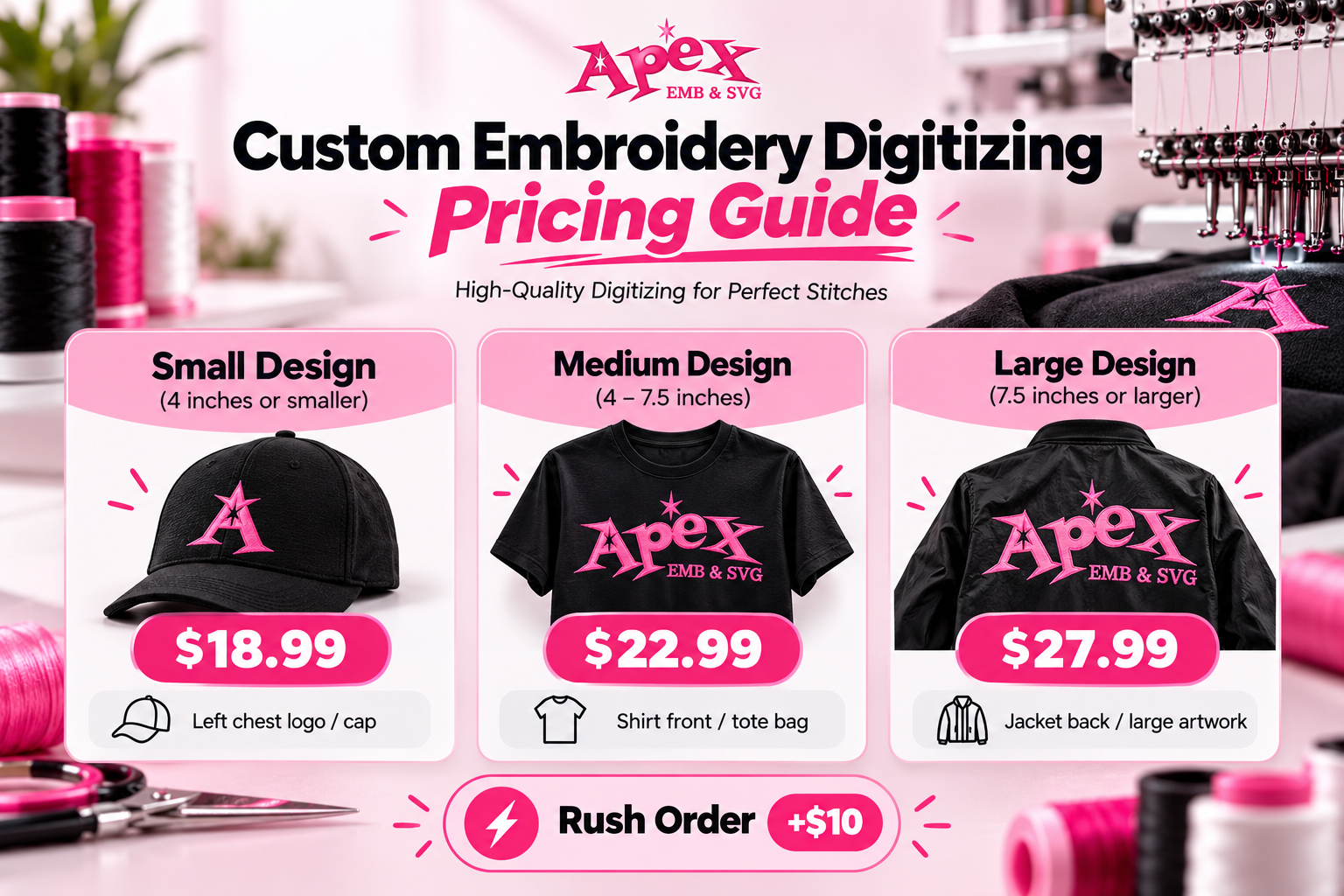
At Apex Embroidery Designs, pricing is based on the size of your final embroidery design.
| Design Size | Apex Price | Common Applications |
|---|---|---|
| Small: 4 inches or smaller | $18.99 | Left-chest logos, caps, small patches |
| Medium: 4–7.5 inches | $22.99 | Shirt fronts, medium logos, tote bags |
| Large: 7.5 inches or larger | $27.99 | Jacket backs, large artwork, blankets |
A rush-order option is also available for an additional $10.
Unlike services that require you to estimate the number of stitches before receiving a price, Apex publishes its standard digitizing rates by design size.
This makes it easier to plan your budget, especially if you're ordering files for multiple embroidery projects.
Need a professional embroidery file? Explore Apex Custom Embroidery Digitizing and choose the size that fits your project.
What Is Embroidery Digitizing, and Why Does It Cost Money?
Before comparing prices, it's important to understand what embroidery digitizing actually involves.
Embroidery digitizing is the process of transforming an image, logo, or artwork into a specialized file that an embroidery machine can interpret.
Unlike an ordinary JPG or PNG image, an embroidery file contains technical instructions that guide the machine through the stitching process.
These instructions include:
- Stitch types and placement
- Stitch direction and sequence
- Stitch density and spacing
- Underlay stitching
- Thread color changes
- Pull compensation
- Trims and jumps
For example, imagine you have a restaurant logo saved as a PNG file. While the image may look perfect on your computer screen, an embroidery machine cannot simply reproduce it as stitches without additional preparation.
A digitizer must determine how the design should be constructed using thread, taking into account details such as fabric stability, lettering, outlines, and overlapping shapes.
This is why embroidery digitizing is more than simply converting an image from one file format to another.
You're paying for the technical work required to turn visual artwork into a design that can be stitched by an embroidery machine.
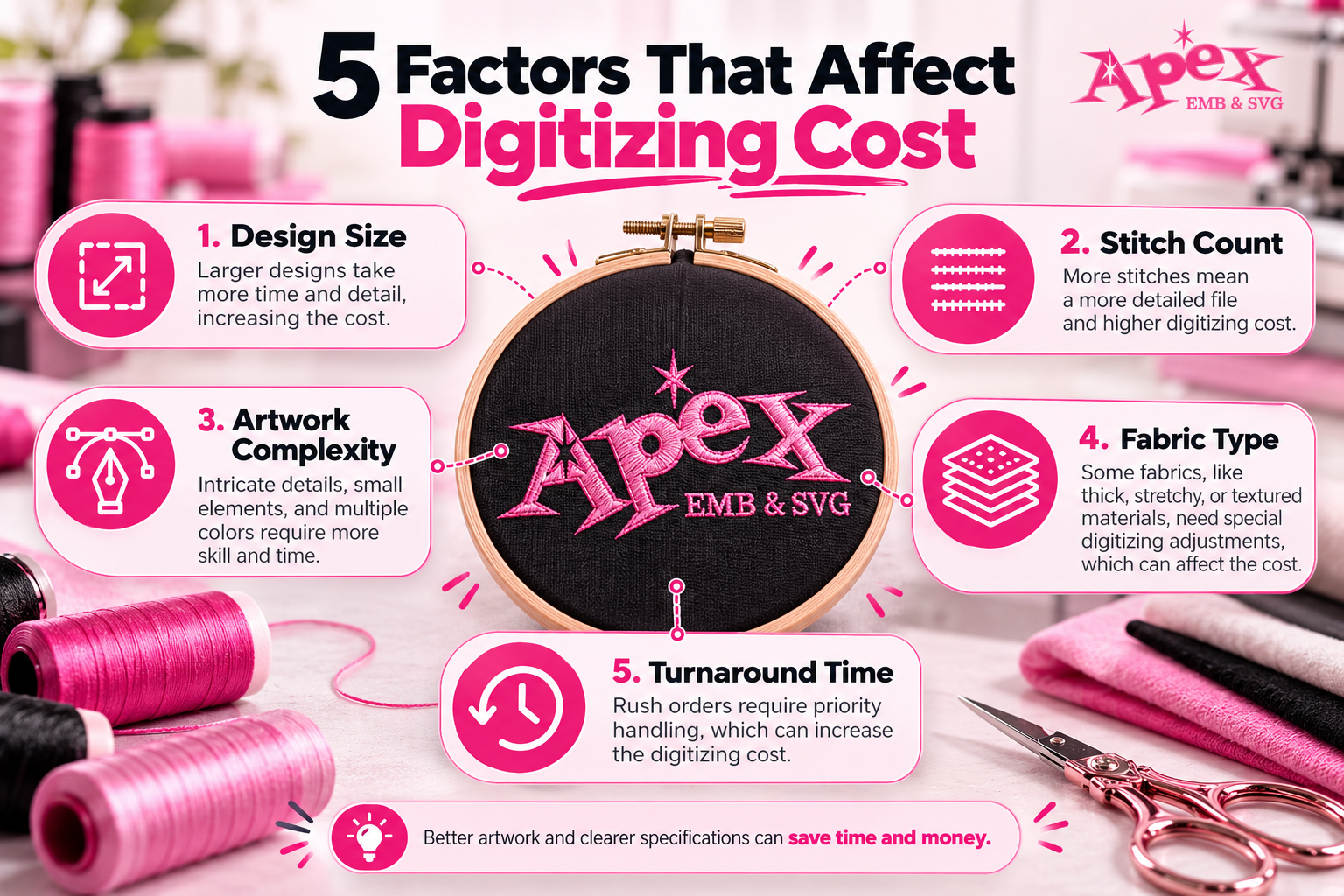
5 Factors That Affect Embroidery Digitizing Cost
Understanding what influences embroidery digitizing prices will help you compare quotes more effectively.
1. Design Size and Stitch Count
The size of your embroidery design can influence how much digitizing work is required.
Larger designs often contain more stitches, particularly when they include filled areas or detailed backgrounds.
For example, a small left-chest logo may require fewer stitches than a large design intended for the back of a jacket.
However, size alone doesn't determine the difficulty of a digitizing project.
A small logo featuring extremely fine lettering may require more careful adjustments than a larger design with simple shapes.
This is why some providers calculate prices using stitch count, while others prefer fixed prices based on dimensions or design complexity.
At Apex, published custom digitizing prices are organized into three size categories, starting at $18.99.
2. Artwork Complexity and Fine Details
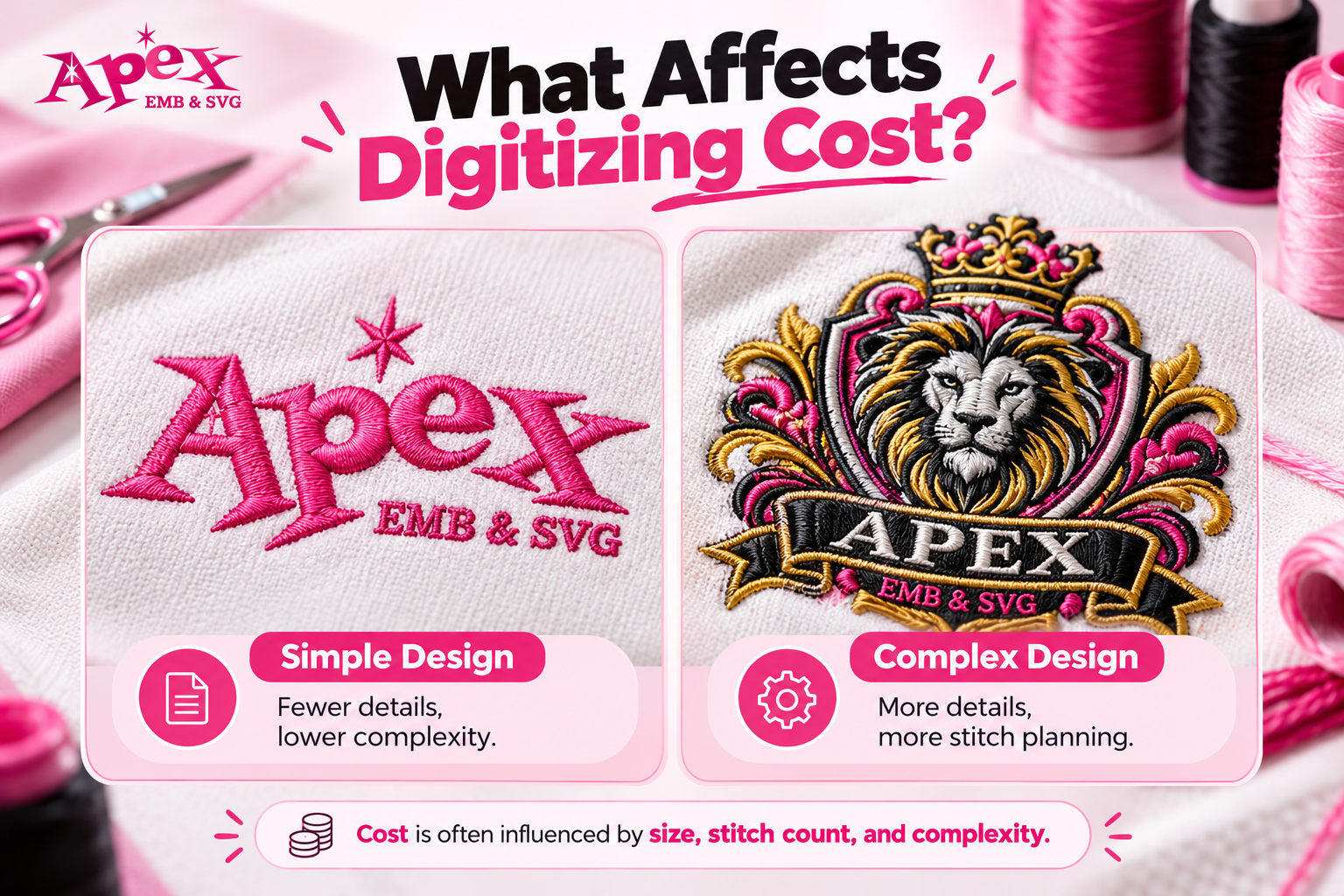
One of the biggest factors affecting logo digitizing cost is design complexity.
Simple artwork usually takes less time to digitize than designs containing intricate details.
For example, compare these two projects:
Design A: A basic company name with bold lettering and a simple icon.
Design B: A detailed company crest featuring tiny lettering, thin borders, multiple colors, and overlapping decorative elements.
Even if both designs have the same overall dimensions, Design B may require significantly more planning and stitch adjustments.
Common details that increase digitizing difficulty include:
- Very small text
- Thin lines and intricate borders
- Overlapping shapes
- Color gradients and shading
- Highly detailed illustrations
- Irregular textures
Some details may also need to be simplified so they remain recognizable when embroidered.
A good digitizer understands how to preserve the visual identity of your artwork while adapting it to the physical limitations of thread and fabric.
3. Fabric Type and Embroidery Placement
Not all fabrics behave the same way under an embroidery machine.
A logo intended for a cotton polo shirt may require different stitch settings from the same logo placed on a stretchy performance shirt or fleece jacket.
The digitizer may need to adjust stitch density, underlay, and pull compensation to account for how the material behaves.
Embroidery placement matters as well.
For example, caps can be more challenging than flat garments because of their curved surfaces and limited embroidery areas.
If you're ordering custom digitizing, it's helpful to specify whether the design will be used on:
- Cotton shirts or polo shirts
- Structured or unstructured caps
- Fleece jackets
- Stretch fabrics
- Tote bags
- Towels
- Patches or promotional accessories
Providing this information in advance can help the digitizer prepare a more suitable file.
4. File Format and Machine Compatibility
Embroidery machines require specific file formats.
Some of the commonly used embroidery formats include:
| File Format | Commonly Associated Machines |
|---|---|
| DST | Tajima and many commercial embroidery systems |
| PES | Brother and Baby Lock |
| JEF | Janome |
| EXP | Melco and some other systems |
| VP3 | Husqvarna Viking and Pfaff |
| HUS | Husqvarna Viking |
| XXX | Singer |
Compatibility depends on the specific machine model, so always check your machine's requirements before ordering.
If you already have an embroidery file but need it in another format, your project may require file conversion rather than complete digitizing.
However, changing the file extension alone doesn't turn an ordinary image into an embroidery-ready design.
Apex offers several embroidery file format options, including DST, PES, JEF, EXP, VP3, ART, and others.
When submitting your artwork, select the appropriate format for your embroidery machine.
5. Turnaround Time and Rush Orders
The speed at which you need your embroidery file may also affect the price.
Standard digitizing orders allow the provider to schedule your project within their normal workflow.
Rush orders require faster handling and may involve an additional fee.
At Apex Embroidery Designs, the advertised standard turnaround is approximately 1–2 days, with a rush-order option available for an additional $10.
If you're preparing for a product launch, promotional event, or uniform order, submitting your artwork early can help you avoid unnecessary rush charges.
Flat-Rate vs. Per-Stitch Embroidery Digitizing Pricing
When comparing embroidery digitizing services, you'll generally encounter two common pricing methods: flat-rate pricing and per-stitch pricing.
Both approaches have advantages depending on your artwork and the provider.
Flat-Rate Digitizing
Flat-rate digitizing means paying a fixed amount determined by the provider's pricing criteria.
These may include design size, type, or complexity.
For example, Apex publishes the following size-based rates:
- Small design: $18.99
- Medium design: $22.99
- Large design: $27.99
The main advantage of this approach is budget predictability.
You can estimate the standard digitizing cost based on your intended design size without calculating stitches in advance.
This can be especially convenient for small business owners ordering logos for employee uniforms, branded merchandise, or promotional products.
Per-Stitch Digitizing
Some digitizing providers charge based on the number of stitches in the completed design.
The fee may be calculated per 1,000 stitches, often with a minimum order charge.
For example, imagine a provider charges $2 per 1,000 stitches.
A design containing 12,000 stitches would cost:
12,000 ÷ 1,000 × $2 = $24
This is an illustrative calculation, not a universal digitizing rate.
The challenge is that customers often don't know the final stitch count until their artwork has already been digitized.
As a result, obtaining an accurate quote may require the provider to review the design first.
Which Pricing Model Is Better?
Neither pricing method is automatically better for every project.
Flat-rate pricing can be convenient for customers who want predictable costs.
Per-stitch pricing may be suitable when a provider uses stitch volume as a consistent basis for quoting work.
Before placing an order, consider the total price, expected file quality, machine compatibility, turnaround time, and any applicable revision charges.
How Much Does It Cost to Digitize a Logo for Embroidery?
For many businesses, logo digitizing is the main reason they need a custom embroidery file.
Whether you're creating uniforms for a local restaurant or launching a branded clothing collection, a digitized logo allows you to reproduce your design using an embroidery machine.
Here are three common scenarios.
Example 1: Small Business Logo on Polo Shirts
Suppose you're preparing embroidered uniforms for a coffee shop.
Your logo is relatively simple and measures approximately 3 inches wide.
At Apex, this would fall within the small-design pricing category of $18.99.
Once you have an appropriate embroidery file, it may be reused for subsequent production runs with compatible settings.
The digitizing fee is separate from the cost of stitching the logo onto individual shirts.
Example 2: Medium-Sized Logo on Tote Bags
Imagine you're creating branded tote bags featuring a 6-inch company logo.
This falls into Apex's medium-design pricing category, priced at $22.99.
A digitizer would need to account for the logo's details and the intended material while preparing the embroidery file.
Example 3: Large Artwork on a Jacket Back
Now imagine you're producing embroidered jackets with a large graphic measuring 10 inches wide.
At Apex, this fits the large-design category, priced at $27.99.
Because jacket-back artwork may contain extensive filled areas or complex details, providing the intended dimensions and garment information is important.
These examples illustrate Apex's published size-based fees. Always confirm the final order details before purchasing.
Why Cheap Embroidery Digitizing Can End Up Costing More
It's tempting to choose the cheapest embroidery digitizing service you can find, especially when several providers appear to offer similar results.
However, a low digitizing fee doesn't necessarily mean lower overall production costs.
Poorly prepared embroidery files can cause problems during stitching.
Excessive Thread Breaks
Unnecessary stitch overlaps, inappropriate density, or poorly planned stitch paths can contribute to thread breaks.
Each interruption slows production and may require manual attention.
For embroidery businesses producing multiple garments, repeated interruptions can become costly.
Fabric Puckering
Puckering occurs when fabric gathers or wrinkles around the embroidered design.
It can result from several factors, including excessive stitch density, inadequate stabilization, tension issues, or unsuitable digitizing settings.
Although digitizing is not the only possible cause, a well-prepared file can reduce certain risks.
Loss of Fine Details
Small lettering and thin outlines may look excellent in the original artwork but become difficult to read once stitched.
Digitizers sometimes need to modify or simplify these elements to preserve the overall appearance of a logo.
Rework and Wasted Materials
Imagine paying $5 for an embroidery file, only to discover it requires extensive adjustments before production.
You may then need to pay for revisions, repeat stitch tests, or commission a new file.
The original low price may no longer be much of a saving.
When choosing embroidery digitizing services, focus on the quality and suitability of the finished file, not just the initial digitizing fee.
How to Save Money on Embroidery Digitizing
Professional embroidery digitizing doesn't have to be expensive.
A little preparation can help you avoid unnecessary charges and reduce the risk of delays.
Start With Clear Artwork
Whenever possible, provide a high-resolution image or clean vector artwork.
Clear artwork helps the digitizer identify important shapes, borders, and lettering.
If your logo is blurry or heavily pixelated, additional interpretation may be required.
Know Your Final Embroidery Size
Determine the approximate dimensions of your embroidery before submitting the design.
For example, a left-chest logo and a jacket-back graphic may need different stitch settings.
Knowing the intended size also makes it easier to select the appropriate service tier.
Specify Your Fabric and Machine Format
Tell your digitizer what material you'll be embroidering and which file format your machine requires.
This can reduce unnecessary communication and help prevent compatibility issues.
Avoid Unnecessary Rush Fees
If your project isn't urgent, use standard turnaround times whenever possible.
At Apex, choosing the standard service instead of the rush option saves the additional $10 rush charge.
Ask About Revisions and Resizing
Before placing an order, check whether design adjustments, resizing, or additional file versions involve extra charges.
Having clear expectations makes it easier to compare different providers fairly.
Why Choose Apex Embroidery Designs for Custom Digitizing?
If you're looking for professional custom embroidery digitizing with transparent pricing, Apex Embroidery Designs offers a straightforward way to turn your artwork into an embroidery-ready file.
With more than 25 years of embroidery digitizing experience, Apex has worked with a variety of customers, from commercial organizations to small businesses and DIY embroidery enthusiasts.
The service covers a wide range of applications, including company logos, apparel, hats, patches, and promotional accessories.
Straightforward Pricing Starting at $18.99
Apex offers three published pricing tiers based on design size, making it easy to identify the standard cost of your order.
Professional Stitch Optimization
Apex's digitizing service includes professional stitch optimization and machine-ready delivery.
The goal is to prepare a file that accounts for the practical requirements of machine embroidery rather than simply reproducing the appearance of the original image.
Multiple Embroidery File Formats
Apex supports popular embroidery formats, including DST, PES, JEF, EXP, VP3, ART, and more.
You can select the format your machine requires when submitting your project.
Fast Turnaround
With an advertised standard turnaround of approximately 1–2 days, Apex can accommodate many custom digitizing projects without a lengthy production wait.
For urgent projects, a rush-order option is also available.
Suitable for Business and Personal Projects
Whether you need one logo for your embroidery machine or you're preparing designs for branded apparel, Apex provides custom digitizing for a variety of project types.
How to Order Custom Embroidery Digitizing at Apex
Getting started is simple:
- Prepare your artwork. Choose the logo, illustration, or design you want to embroider.
- Select your design size. Choose the appropriate small, medium, or large category.
- Enter your project details. Provide the intended width, number of colors, and fabric type.
- Upload your artwork. Attach the image you want digitized.
- Choose your embroidery file format. Select the format compatible with your machine.
- Submit your order. Review your options, choose rush service if needed, and complete your purchase.
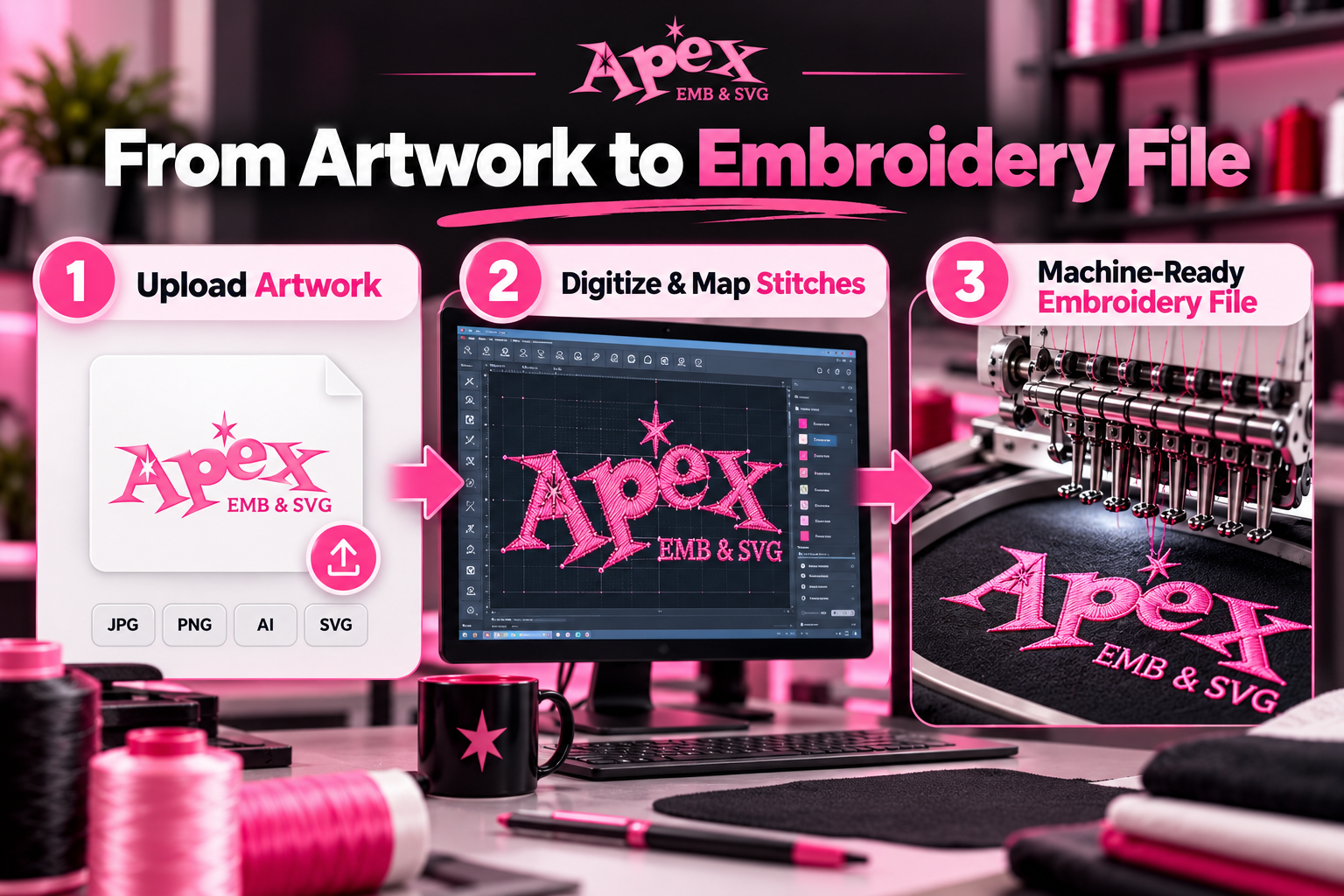
You can also use the additional information field to communicate important details about your design.
Ready to turn your logo into embroidery?
Order Custom Embroidery Digitizing at Apex — Starting at $18.99 →
Frequently Asked Questions About Embroidery Digitizing Cost
How much does it cost to digitize a logo for embroidery?
A small business logo typically costs around $10–$25 to digitize, although detailed artwork may cost more. Apex Embroidery Designs offers custom logo digitizing starting at $18.99 for designs measuring 4 inches or smaller.
How much does embroidery digitizing cost per 1,000 stitches?
Some providers charge by stitch count, using a price per 1,000 stitches and sometimes a minimum fee. For example, at an illustrative rate of $2 per 1,000 stitches, a 10,000-stitch design would cost $20. Other providers, including Apex, use size-based pricing instead.
Is embroidery digitizing a one-time fee?
Embroidery digitizing is generally a one-time cost for creating a particular embroidery file. Once the file is prepared, it can often be reused for subsequent embroidery runs. However, major resizing, artwork changes, or different fabric applications may require adjustments or additional digitizing work.
Does a higher stitch count mean higher digitizing cost?
Not necessarily. Providers using per-stitch pricing may charge more for designs with higher stitch counts. However, flat-rate services may base their prices on size or complexity instead. A small but intricate logo can sometimes be more challenging to digitize than a larger, simpler design.
How long does custom embroidery digitizing take?
Turnaround time varies by provider and project. Apex Embroidery Designs advertises a standard turnaround of approximately 1–2 days and also offers a rush-order option for an additional $10.
Can I convert a PNG or JPG into an embroidery file?
Yes, but the image must be properly digitized. Simply renaming a PNG or JPG file to DST, PES, or another embroidery format will not create usable stitch instructions. A digitizing process is needed to convert the artwork into machine-readable embroidery data.
What is the difference between embroidery digitizing and embroidery setup fees?
Embroidery digitizing refers to preparing the digital stitch file. An embroidery setup fee is a separate charge that some embroidery shops apply when preparing a production job. Depending on the provider, a setup fee may include digitizing, machine preparation, or other services. Always ask what is included in your quote.
Can I reuse a digitized logo on different products?
Often, yes, provided the file is suitable for the required size, fabric, and embroidery placement. For example, a logo prepared for a cotton polo shirt may need adjustments before it is used on a structured cap. Reusing the same file without checking these factors can affect the finished result.
Final Thoughts: Is Professional Embroidery Digitizing Worth the Cost?
Embroidery digitizing is an essential step in turning your artwork into a design that an embroidery machine can stitch.
While prices vary depending on size, stitch count, complexity, and turnaround time, choosing the right digitizing service can help reduce production problems and unnecessary rework.
In 2026, small logo digitizing commonly falls within the $10–$25 range, while larger or more intricate designs may cost considerably more.
For customers who prefer clear, size-based pricing, Apex Embroidery Designs offers custom embroidery digitizing starting at $18.99, backed by more than 25 years of experience.
Whether you're creating branded uniforms, personalized gifts, or custom apparel, having the right embroidery file is the foundation of a successful project.
Bring your artwork to life with professional embroidery digitizing.